Lessons from Livy’s Ab urbe condita
Captured by Rabbi Ben Scolnic
Edited by Altay Coskun
Summer 2026
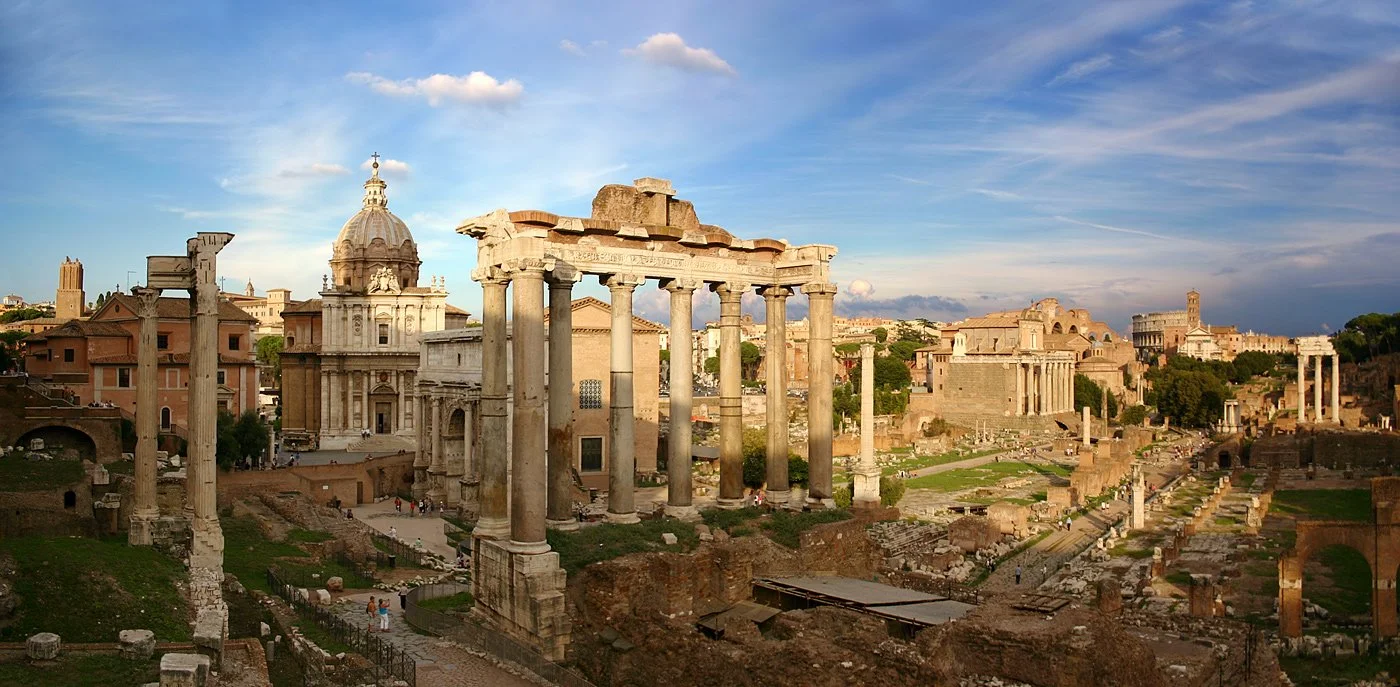
View on the Forum Romanum from Capitoline Hill. Photography: Stefan Bauer, 2005. Source: Wikipedia.
Trying to understand what made Rome into the most powerful empire of all times, Rabbi Ben returned to reading Livy’s Ab urbe condita many years after having studied parts of it as an undergraduate student. Then it had appeared to him like a daunting piece of antiquarian scholarship with some nationalistic finish, collecting all the details of over 750 years of Roman history in 142 volumes (of which 35 survive). The stories seemed to be telling the Romans how great they were, thanks to their heroic bloodline that made them the descendants of the Trojans and owed to the favor of the gods that they enjoyed before even the city’s foundation by Romulus.
Much matured, however, through life and study, Ben’s rereading brought to light a very different message that might even speak to us today. At the beginning of all good things, the city foundation, her constitutional safeguards, her growth in wealth and power, came toil and sacrifice. Glory is nothing you start with, but striving hard, always facing failure as a possible outcome, yet holding course in solidarity, with courage and purpose - this is the path to success and excellence that Livy was whispering into Ben’s ears while the grand narrative was playing out before his eyes with the turning of page after page ...
-
I am Titus Livius of Patavium, and I have spent my life's breath tracing the span of seven hundred years—from the humble shepherd's huts on the Palatine to this immense Empire which now labors under its own weight. Men of a lesser age mistake silence for stability and consensus for strength. They look upon the "tumults" of early Rome—the shouting in the Forum and the secessions of the Plebeians—as a fever to be cured. But as I recorded in the First Secession (Book 2.32), when the Plebs withdrew to the Sacred Mount, the state discovered its own necessity. Consider the wisdom of Menenius Agrippa, who taught us that the "belly and the limbs" must work in concert; a city that does not breathe through its tensions is a city that has already begun to suffocate.
This discord was the crucible of our greatness. Those modern thinkers who condemn the friction between the Senate and the Plebs see only the noise, missing the beautiful, unintended architecture it built. They do not see that in every republic there are two distinct humors—that of the great, who wish to dominate, and that of the people, who wish merely not to be dominated. In the long struggle for the Terentilian Law (Book 3.9), the people’s demand for written laws was not an act of rebellion, but a refusal to be crushed by the unwritten biases of the nobility. They understood that without a public record of the law, the magistrate is merely a tyrant in a toga.
When the Licinian-Sextian Rogations (Book 6.42) finally opened the Consulship to the Plebeians, it proved that a state must allow its internal "modes" to evolve if it wishes to expand. By allowing the people to share in the honors of the state, we ensured they would share in its burdens. Because a Roman knows he has a voice in the Forum and a shield in the law, he fights as a part-owner of the Republic.
If Rome wished to remain quiet, she would have had to remain small; but to remain small is to invite destruction by those who grow. It is better to have a city of restless, free men who are invincible in the field than a quiet, orderly graveyard of slaves who will flee at the first glitter of an enemy spear.
-
I did not write my history to amuse the idle; I wrote it because the study of the past is the best medicine for a sick mind. You who study the fortifications of the East often forget that stone is a liar. A fortress is only as formidable as the spirit of the men who man the ramparts; a fortress can be lost by treason or cowardice, but a well-ordered citizen-army is a fortress in itself. In Rome, we understood from the time of Numa Pompilius (Book 1.19) that the "Orders" of the state must be anchored in something more enduring than mere human decree. Numa realized that a city forged in violence required the "fear of the gods" to civilize its savage soldiers and ensure their oaths were more than empty breath. He knew that law alone could not restrain a martial people; they required a divine witness to their conduct. Indeed, where there is religion, military discipline is easily introduced, but where there is only a military without religion, the state is a house built on sand.
The strength of this internal citadel is best seen when the physical walls have failed. Witness the Devotio of the Decii (Book 8.9), where a commander, by his own ritual sacrifice, turned the tide of battle through sheer religious certainty. This was not a primitive superstition, but a strategic mastery of the Roman soul. Religion is the "cement" of military discipline and civic duty.
Even when men are tempted to lie for the sake of morale, as did the keeper of the sacred chickens at Aquilonia (Book 10.40), the state maintains the ritual to preserve the soldier's spirit. The Consul Papirius understood that the ritual’s utility outweighed the truth of the omen; he turned the blame of the false augury onto the pullarius himself, executing him while the soldiers marched forward convinced of Heaven's favor. A soldier who believes the heavens have sanctioned his march is a fortification that no siege engine can breach. A city may lose its outer walls, but as long as its "internal citadel"—its reverence for the ancestral customs and the valid terror of breaking an oath—remains intact, it can never truly be conquered.
-
I have set down these "modes" so that those who come after may see how a small seed became a world-spanning oak. To win a battle is the work of a day; to maintain an empire is the work of centuries. Rome’s greatness lies in our "Modes and Orders," a system designed to outlast any individual and to absorb any defeat. Look to the aftermath of Cannae (Book 22.61): even with Hannibal at our gates, the Senate refused to ransom the prisoners. This was not cruelty, but a declaration that the Republic’s discipline is absolute and its resolve is infinite. We showed the world that a Roman is either a victor or a corpse; there is no middle ground. A prince or republic that bows to misfortune will find that its neighbors only press harder; but those who show no fear compel others to seek their terms.
Our strategy is one of relentless resilience. We do not rely on a single wall, but on a network of colonies (Book 27.10) that act as "living garrisons" to hold the land even when the enemy marches through it. These colonies cost the Republic little, yet they root our law deep into foreign soil, dispossessing only those who are too broken to rebel.
Furthermore, we use the sophisticated lever of the hostage-ship, as seen when we held Demetrios of Macedon and Antiochos of the Seleukids (Book 33.13). By taking the sons of kings and educating them in our shadow, we turn the future rulers of the world into Romans in spirit before they ever take the throne. When they return to their peoples, they rule not as sovereign kings, but as our prefects. This paralyzes the wills of our enemies and ensures the stability of the frontier without firing a single bolt. This is the "slow siege"—the weaving of neighbors into a web of Roman law and dependency.
An empire built on the shifting sands of a single military genius will fall when that genius dies, but an empire built on the bedrock of superior social and political orders will endure as long as the sun rises over the Capitoline.
-
I have set down these "modes" so that those who come after may see how a small seed became a world-spanning oak. To win a battle is the work of a day; to maintain an empire is the work of centuries. Rome’s greatness lies in our "Modes and Orders," a system designed to outlast any individual and to absorb any defeat. Look to the Aftermath of Cannae (Book 22.61): even with Hannibal at our gates, the Senate refused to ransom the prisoners. This was not cruelty, but a declaration that the Republic’s discipline is absolute and its resolve is infinite. We showed the world that a Roman is either a victor or a corpse; there is no middle ground. A prince or republic that bows to misfortune will find that its neighbors only press harder; but those who show no fear compel others to seek their terms.
Our strategy is one of relentless resilience. We do not rely on a single wall, but on a network of colonies (Book 27.10) that act as "living garrisons" to hold the land even when the enemy marches through it. These colonies cost the Republic little, yet they root our law deep into foreign soil.
Furthermore, we use the sophisticated lever of the hostage-ship, as seen when we held Demetrius of Macedon and Antiochus (IV) of the Seleucids (Book 33.13). By taking the sons of kings and educating them among us, we turn the future rulers of the world into Romans in spirit before they ever take the throne. When they return to their peoples, they rule not as sovereign kings, but as our prefects. This paralyzes the wills of our enemies and ensures the stability of the frontier without firing a single bolt. This is the "slow siege"—the weaving of neighbors into a web of Roman law, friendship, and dependency. An empire built on the shifting sands of a single military genius will fall when that genius dies, but an empire built on the bedrock of superior social and political orders will endure as long as the sun rises over the Capitoline.
-
Let those who marvel at our triumphs also study the slow poison that dissolved our liberty. A republic that wishes to remain free must be jealous of its honors and, above all, swift in its rotation of power. In the early days, a consul wielded the lightning of the state for a single year, then returned to his plow, a private citizen subject to the very laws he had enforced. But as our wars stretched beyond the seas, we committed a fatal error: we began the prolongation of commands (prorogatio imperii), as when we extended the imperium of Publilius Philo (Book 8.23). We believed it a matter of military necessity, a way to keep an experienced hand at the wheel of a distant war.
We did not see that we were trading the safety of the state for the ambition of men. When a general commands the same legions for years on end, the soldiers forget the Senate; they forget the Republic. They begin to look to their commander for their pay, their plunder, and their land. The army ceases to be the shield of Rome and becomes the private retinue of a warlord. It was this very innovation, born of convenience, that paved the road for Sulla, for Caesar, and for the ruin of our ancestral freedom. To prolong a command is to shorten the life of liberty; it is better for a war to be delayed or mismanaged by an inexperienced, legal consul than for it to be won by a general who becomes greater than the law.
-
A state that cannot cleanse itself from within will soon be torn apart from without. Many look upon the trial of Marcus Manlius Capitolinus (Book 6.20) – the very hero who saved the citadel from the Gauls – and weep at his execution. They see it as ingratitude. But they fail to see that a republic must possess a legitimate, legal outlet for the people's envy and suspicion against the great. Nothing makes a republic more stable and solid than organizing it in such a way that the alteration of those humors that agitate it has a way prescribed by law. By allowing formal accusations, we give the multitude a way to vent their anger against ambitious citizens without resorting to private vendettas or inviting foreign intervention.
If an unruly citizen cannot be broken by the law, he will be broken by the dagger, and that is the end of the civil order. Conversely, we must ruthlessly punish those who spread calumnies – unverified rumors whispered in corners – for calumnies inflame hatred without offering proof, whereas an accusation demands evidence before a judge. Look also to how Rome periodically returned to its first principles. Every few generations, through the dread power of the Censorship or the terrifying spectacle of a dictator, the citizens were reminded of the old punishments and the ancient virtues. A political body, like a human body, gathers corrupt humors over time. Unless it is violently brought back to its origins – reminded of the fear that made it great – it will rot from its own internal luxury.
-
In matters of state and war, the lukewarm path is the road to absolute ruin. Men of weak resolve always seek a middle course, believing that moderation will placate their enemies and preserve their safety. They are fools. I have recorded the definitive lesson of this in the story of the Caudine Forks (Book 9.3). When our legions were trapped in the mountain pass by the Samnites, the old statesman Herennius Pontius gave his son two options: either slaughter every Roman to a man, thereby breaking our power for generations, or release them all with honor and without conditions, thereby binding us to a perpetual friendship.
Instead, the young Samnite general chose the middle course. He spared our lives but humiliated us, forcing our soldiers to pass under the yoke. He gave us life, but left us with our hatred intact. He reaped neither the security of our destruction nor the gratitude of our friendship. The Senate soon repudiated the peace, and our legions returned with a fury that did not rest until Samnium was ashes. When the safety of the state is at stake, no consideration of justice or injustice, of mercy or cruelty, of praise or ignominy, should be permitted to interpose. You must either benefit men or destroy them; if you merely wound them, they live to take their revenge. A republic that does not know how to be entirely good or magnificently bad will find itself crushed by those who do not hesitate.
-
When the plebeian host, weary of debt and the haughty cruelty of the patricians, withdrew from the city walls and fortified themselves upon the Sacred Mount, a terrible and deathly silence fell over Rome. In the Forum, men looked upon empty streets, the nobility paralyzed by fear, the commoners who remained distrustful of their neighbors, each wondering if civil bloodshed would finish the ruin that foreign enemies had begun.
The elders of the Senate, long accustomed to unbridled mastery, cried out that the republic was decapitated, that this secession was an act of fatal madness. Yet, how narrow is the vision of men who mistake the quietude of servitude for the health of a state! For it was not ruin that was forged upon that hill, but the very safeguard of Roman liberty.
By yielding to necessity and granting the people their own sacrosanct magistrates—the Tribunes—the state did not fracture its majesty; it anchored it. The nature of a free city demands that no single order possess the power to utterly crush the other. The patricians sought to dominate, the plebeians to live in safety; from the fierce, clashing currents of these two human ambitions, a balanced constitution was born. Let those who condemn the ancient clamor of our assemblies realize that without the sharp friction of the forge, the iron of our laws could never have been tempered to endure the weight of empire.
-
The scales were set in the ruined Forum, and the gold of a defeated people was weighed out to satisfy the greed of the victorious Gauls. When the Roman commissioners protested the blatant fraud of the weights, the barbarian king Brennus, insolent in his triumph, unbuckled his heavy iron sword and cast it onto the balance, uttering those words that must forever burn the ears of free men: 'Vae victis!'—woe to the vanquished.
It was in this moment of absolute degradation, when Rome’s honor hung by a thread of shameful commerce, that Marcus Furius Camillus, appointed Dictator by the desperate remnant on the Citadel, appeared with his legions. He commanded the gold to be removed, declaring that it was the Roman custom to redeem their fatherland not with gold, but with iron.
To the poets, this stands as a shining testament to unyielding virtue; to the statesman, it is an eternal lesson in the necessity of total victory. A republic that purchases its peace with treasure does not buy safety; it merely buys an interval of truce, funding its enemy's next invasion with its own wealth. Camillus understood that in the calculus of war, half-measures are an invitation to slaughter. An enemy must either be bound by such absolute generosity that their hatred is unlearned, or broken so utterly that their posture of defiance is rendered impossible. By sword and by blood, Camillus chose to preserve the state, leaving no remnant of the barbarian host to carry home the news of their arrogance.
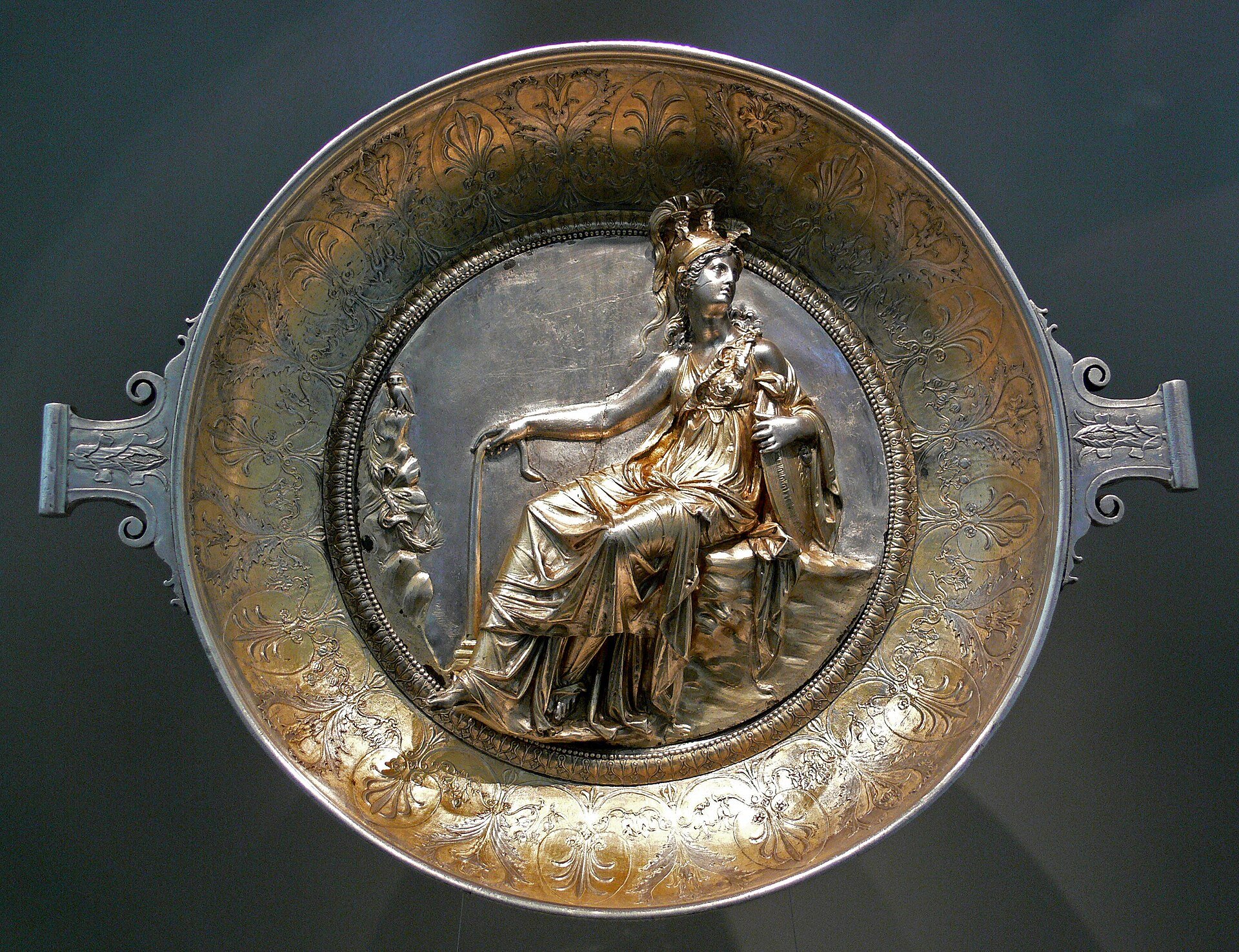
Minerva on the Silver Bowl from Hildesheim, probably produced in Alexandria, 1st century CE. Her majestic depiction can be read as the embodiment of strength and imperial power. Photograph: Andreas Praefke, 2006. Source: Wikipedia.