Hesiod and the Whispers of the Muses
Delivered to Rabbi Ben Scolnic
Edited by Altay Coskun
March 2026
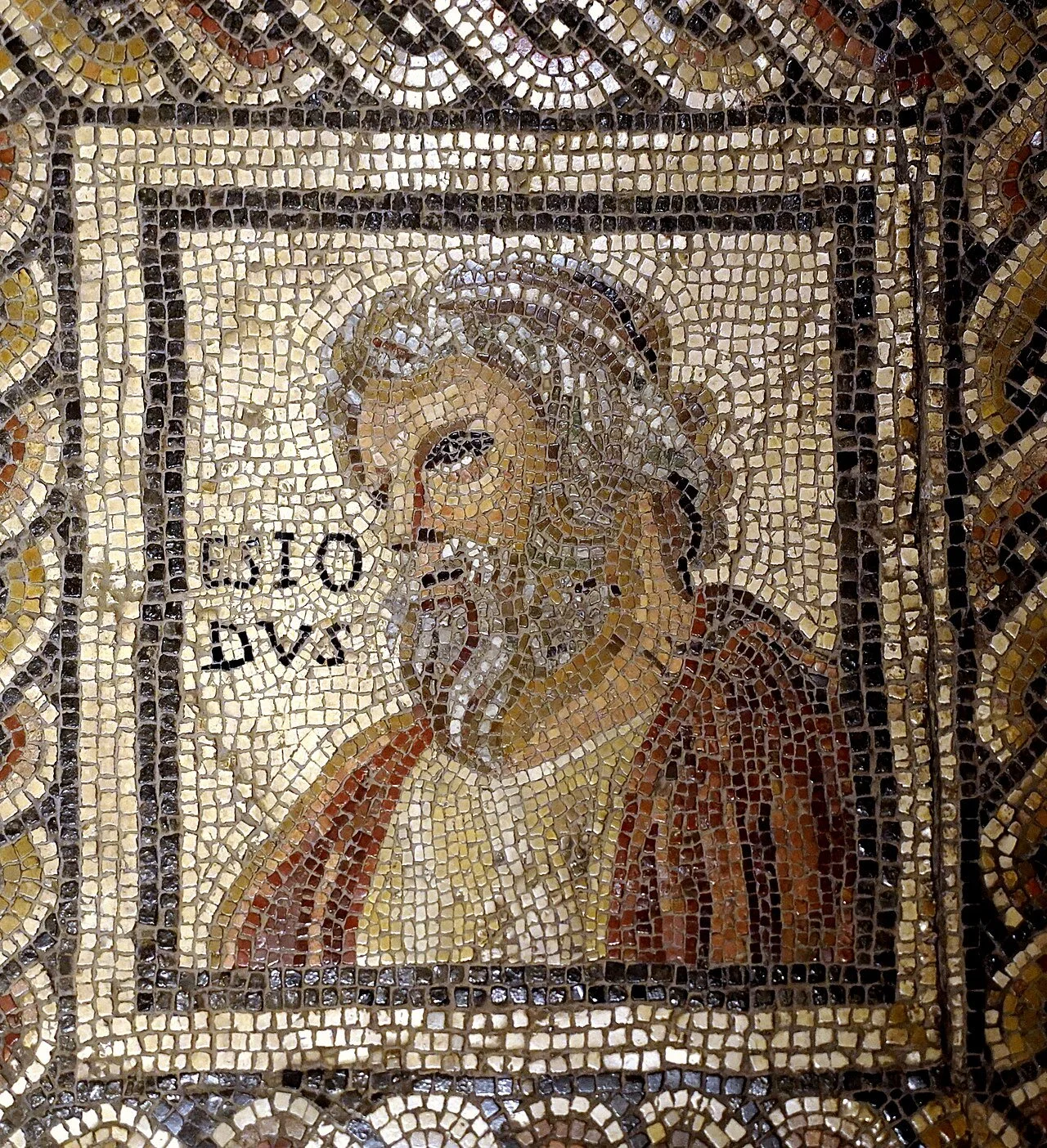
Late Roman Mosaic depicting Hesiod from the Mosel Valley, now Rheinisches Landesmuseum Trier.
A younger contemporary of Homer, Hesiod of Boeotian Ascra in central Greece wrote his partly autobiographical poetry around 700 BCE. His main works, the Theogonia (‘Birth of Gods’) and Erga kai hemerai (‘Works and Days’) reveal a more rigorous and systematic character than the Iliad and the Odyssey. While Homer dwells on grand narrative, tragic causation, and the allures of the exotic, Hesiod is taken in by what sustains life and holds human society together: on the one hand, the greatness of the divine in all its ramification, on the other hand, the detail of daily rural chores interwoven with the marvel of the regenerative force of nature. Hesiod may have followed in the footsteps of Homer as epic poet but created didactic literature in verse to educate the young and the common people at large. Yet he conveyed more than just factual information by instilling awe for the tangible nature and metaphysical forces in his audience. True enough, a pessimistic tone runs through his work, rooted in his personal experience of the harsh human condition and not rarely exacerbated by the cruelties inflicted by man on man. But this is balanced by his admiration of life and renewal, and by the divine as ultimate avenger of evil. It is this firm belief in divine justice that makes him akin to the Father of History Herodotus and to Biblical authors, and thus explains his appeal to Rabbi Ben. And so another series of dreams have been inspired by the Muses, the light-footed beauties dancing on Mount Helikon and turning Boeotia into another Tempe Valley, by breathing life into the verses Hesiod. And would you believe? They are still around chasing the echoes of the Ascraean poet in their cheerful dances, purring like breezes into Ben’s ears during his spring-time naps.
-
Ascra is a miserable village in winter, unbearable in summer, and seldom good at any time. My father fled here from Cyme across the dark sea, fleeing poverty, not realizing he was trading the terrifying whims of the sea for the equally terrifying whims of the local lords. When he died, he left what little he had scratched from this harsh Boeotian dirt to my brother, Perses, and me. I wanted only to divide it fairly, to take my plow to my half and let the seasons dictate my fortune. But Perses had the ear of the basileis—the bribe-swallowing lords who sit in the high seats and pass judgment over our lives. He slipped gifts into their greedy hands, and with a few crooked words, they gave him my livelihood.
I watched them deliver their false verdicts, men draped in the trappings of authority, convinced that their word alone constituted the law. We men of the earth labor endlessly to build great stone walls around our cities, trusting in their sheer mass or perhaps the magic of their consecration to keep the enemy at bay. We think the danger always comes from the outside. But what good is a sacred, towering wall, what good are ramparts and watchtowers, when the rot is already inside the gates? A city that harbors crooked judges has already breached its own defenses from within.
It was in the bitter cold of that loss that I understood a truth those lords will forever ignore: Justice—Dike—is not an invention of kings. It is not whatever the powerful decree it to be in the town square. It is the daughter of Zeus. When corrupt men drive her out with crooked judgments, she wraps herself in mist, walks through the streets weeping, and brings ruin upon the entire city. The crops fail, the women bear no children, and the great walls eventually crumble. The lords may feast today on the bribes they swallowed, but they are eating the seed corn of their own destruction. There is a divine, immovable order to the world that bends toward righteousness, not the whims of tyrants. I write my verses not merely to win back a patch of stolen dirt, but to warn them: the eye of Zeus sees everything, and he does not forgive those who mock his daughter.
-
When I was a younger, more foolish poet, I thought of Eris (‘Strife’) as a single, terrifying force. I sang of her only as the bloody-handed goddess who walks the battlefield, the one who drives men to slaughter each other over a barren strip of land or an imagined slight. I have heard the endless, grim tales of ancient warfare—of men freezing in squalid winter quarters, of grinding, years-long sieges designed to slowly starve a populace into submission, of kings taking the sons of their rivals as hostages to enforce a fragile, bitter peace. It is a terrible, consuming fire that leaves nothing but ash, orphans, and weeping widows. If that were the only Strife in the world, humanity would have been extinguished long ago by its own hand.
But age, and a long life observing the mechanics of the world, have taught me to correct my own songs. I look around my village, and I see that there are actually two goddesses of Strife on this earth. The first is that cruel mother of war and sieges. But the second is older, born of the dark night, and Zeus placed her in the very roots of the earth to help us.
This second Strife is the one that makes a man build a better, swifter ship because he sees his neighbor’s wealth growing. It is the fierce envy that drives the potter to shape a finer, more elegant vessel than the potter next door, or the builder to lay a straighter, stronger wall. This good Strife does not demand hostages or blood. She demands excellence. She stirs even the laziest, most shiftless man to work. When a man sees his neighbor rushing to plant his fields and order his house before the winter rains, he feels the sharp sting of that good Strife and reaches for his own plow. We must turn our backs entirely on the goddess of the battlefield. The true test of a man is not how long he can endure a winter siege to destroy another city, but how hard he is willing to strive to build his own.
-
I look at the men of my generation, and my heart is heavy with a sorrow that stretches back to the beginning of time. I wish to all the gods that I had died before this Age of Iron, or had been born long after it, for our time is one of unceasing labor, broken oaths, and profound grief. But to understand our current doom, you must understand the men who came before us, particularly the terrifying race of the men of Bronze.
The Bronze men were a nightmare walking upon the earth, a heavy-handed race who sprang from ash trees and cared nothing for the plow, the harvest, or the quiet life of the hearth. Consumed by their love for the terrible groan of war and acts of unspeakable violence, they ate no bread and possessed hearts as hard and unforgiving as adamant and flint. Long before the advent of black iron, they forged everything—their heavy armor, their sprawling houses, and their lethal weapons—entirely of bronze. Believing their sheer martial power and mastery of weaponry made them invincible gods, they built massive armies to secure an eternal legacy, but their only reward for such terrible strength was their own undoing; they destroyed themselves with their own hands and passed into the dark, chilling house of Hades, leaving no name behind them.
The gods did not need to hurl thunderbolts to destroy them. The Earth did not swallow them up. The Bronze men were destroyed entirely by their own hands. Their absolute obsession with warfare, their reliance on the sword and the spear to solve every grievance, was a poison they brewed and drank themselves. They slaughtered each other into absolute extinction, passing down into the dark, lightless house of Hades and leaving no names behind.
For Hesiod’s fuller view on the succession of ages, read his Works and Days, 109–201.
-
You ask why we must remember this. You ask why we must recite the long, wearying lines of fathers and sons, of mothers and monsters, back to the very dawn of creation. It is because blood is the memory of the Earth, and to know a thing’s birth is to know its inescapable nature. You cannot grasp the bitter fruit of our current doom without first tracing the twisted roots from which the tree of man has grown.
Genealogy is not the idle boasting of kings; it is the absolute architecture of the cosmos. When the Muses, the daughters of Memory, breathed their divine voice into me upon the slopes of Mount Helicon, they did not sing of fleeting things. They sang of what was, and what is, and what is to come—and all of it is bound by the unbreakable chain of birth.
Through lineage, we understand the architecture of divine justice. Even wide-seeing Zeus holds his thunderous throne by right of succession and the overthrow of his father, Cronus, who in turn struck down his own father, starry Ouranus. The universe is governed by inheritance.
And look to the dark progeny that plagues us now! We must know that black Night gave birth to Doom, and to pitiless Death, and to hard-hearted Strife. And what did Strife bear? She gave birth to Toil, Forgetfulness, Famine, and tearful Sorrows. These are the relentless companions of our Iron generation. We suffer not by accident, but because we are forced to walk alongside these ancient, dark children of the cosmos. They are our cousins in the fabric of creation.
By remembering the generations, we measure the length of our fall. We remember the Golden race who lived like gods without sorrow, and the Silver race who lacked the wits to revere the immortals. We remember the brief, glorious interruption of the Heroic race, the demigods who fought at Troy and Thebes, whose blood was a final, flickering ember of nobility before the gods gave us over to this wretched age.
-
Now, we are the men of Iron. We mix our daily misery with wickedness. Might makes right in our streets, guests turn on their hosts, and reverence for the gods is fading into memory. I fear we are walking the exact, blood-soaked path of the Bronze men. When a society structures its entire existence around the capacity for violence, when it praises the warrior above the farmer and the judge, it is simply building its own funeral pyre. The Bronze men show us the inevitable trajectory of violence: it does not lead to eternal glory. It leads only to mutually assured destruction—to the dark, silent earth, where all our grand weapons rust uselessly beside our bones.
And what halts our descent into that dark earth? Nothing. For the final, most terrible omen is already upon us.
I see them wrapping their beautiful, shining white robes about their immortal shoulders. Aidos and Nemesis are leaving us. They are abandoning the blood-stained dust of the earth to join the deathless gods on Olympus, and with them goes the very soul of our humanity.
Mourn for Aidos! She was the blush of shame on the cheek of the wrongdoer, the quiet reverence we once held for the old, the sacred, and the vulnerable. She was the invisible boundary that kept men from becoming beasts. Without her, there is no hesitation before the strike, no guilt after the theft. The wicked man will speak with a smooth tongue and a black heart, and he will feel nothing.
And weep for Nemesis! The soft-spoken philosophers of tomorrow might try to lessen her, calling her mere 'Indignation'—a fleeting, helpless anger at the sight of injustice. Fools. They do not know what we are losing. She is not merely the offended gasp of the righteous; she is the Avenger. She is the cosmic counterweight, the divine consequence that shatters hubris and snaps the scales of justice back into balance. When a man grew too proud, too violent, too greedy, it was the Avenger who brought the hammer down upon his house.
But no longer. By leaving us, Nemesis takes consequence with her. The wicked will flourish without fear of retribution. The good will suffer without hope of vindication.
Left behind is only bitter sorrow for mortal men. We are stripped of our protectors, entirely defenseless against the encroaching evil. The iron in our hearts has driven away the last of the divine light, and we are left alone in the dark to devour ourselves.
-
My brother Perses, like so many fools in this world, believes that wealth and comfort should come easily. He looks at the lords in their fine woolen cloaks, spending their days lingering in the agora, listening to lawsuits and trading idle gossip, and he deeply envies their idleness. He thinks that sweat is a curse, that dirt under the fingernails is a mark of the lowly, and that true success means escaping work altogether. I have spent my life trying to beat this foolishness out of his head with my words.
Work is no disgrace; it is idleness that is the true, rotting shame of a man's soul. The gods have ordained that the road to excellence—arete—is incredibly steep, long, and covered in sweat. You do not find virtue standing in the town square, shouting over petty disputes. You find it long before dawn, when the air is biting cold, yoking the heavy oxen and cutting the first difficult furrow into the dark, resisting earth. You find it in the relentless, rhythmic obedience to the seasons: pruning the vines precisely when the swallow returns, and harvesting the grain the moment the Pleiades rise in the sky.
There is a quiet, profound, and sacred dignity in this daily maintenance of human life. The men who grow the grain, who build the sturdy wagons, who shear the sheep in the spring—we are the ones who hold the world together. We keep society from collapsing into starvation and chaos. The idle lords may wear the crowns and hand down the judgments, but it is the calloused hand of the laborer that sustains the very breath of the city. To work the earth is to enter into a holy rhythm with the cosmos. It is the only honest way to fill your barns and keep the grim, skeletal specter of famine from peering through your window. Let Perses have his crooked lawsuits and his idle dreams. I will take my plow, for it is the only tool that yields true, lasting, and honorable wealth.
-
Why must we labor so brutally just to survive? Why does the earth not simply bring forth grain on its own, as the old tales say it did during the Golden Age? The answer lies in the ancient anger of Zeus. The gods have deliberately hidden the easy means of life from humanity, burying our sustenance deep in the soil and tying it to the cruel turning of the seasons.
It began with Prometheus, who thought he could outsmart the king of the gods. He stole the fire and brought it to us, thinking he was giving humanity total dominion over the world, freeing us from the dark and the cold. But Zeus is not mocked, and nature cannot be cheated. In return for the stolen fire, he gave us a beautiful, terrible gift: Pandora, and with her, he unleashed toil, sickness, and exhausting, unending labor upon the earth. The easy life was locked away forever.
This is the harsh ecological reality we must accept: the earth is not an endless, overflowing horn of plenty. It is stubborn, it is profoundly finite, and it requires our blood and sweat to yield its fruits. The spring rains may fail; the brutal summer heat may scorch the vines before they ripen; the bitter month of Lenaion may drag on until the barley runs out and the cattle starve. We are always, in every generation, just one bad harvest away from absolute ruin.
Therefore, a man must be fiercely practical. He must gather his resources carefully, wasting nothing. He must not presume that tomorrow will be bountiful just because today is comfortable. We are bound by the absolute limits of the natural world, and any man who thinks he can cheat the soil, exhaust his fields, or ignore the changing of the constellations is a fool inviting starvation into his home. We live in a world of strict scarcity, and our only defense against it is tireless work, careful preservation of what we have, and a deep, fearful reverence for the boundaries the gods have drawn around us.
-
Zeus whose voice is borne on the thunder has established strict boundaries for the earth, and he has placed the same iron laws upon the work of our hands and the span of our days. Fools are they who think they can force the harvest out of season, or drive an exhausted people as if they were fresh horses in the spring.
And what of the people you guide? An assembly of men and women is not a machine of bronze that strikes the same note day after day; it is a living field subject to the shifting winds.
A wise leader must look up and read the faces of his people just as the farmer watches the Pleiades. Are they battered by the storms of grief, exhausted, and seeking shelter? If so, it is the season of wintering. Give them rest, for any man who demands heavy lifting from a starving ox will find himself with a broken yoke and a dead beast. But when the spring returns and you see the light of restlessness and strength in their eyes, that is the time to lead them into new endeavors. To lead well is not to force your will upon the crowd, but to align your commands with the seasonal readiness of their hearts.
Finally, consider the span of your own days. You have stood before your people and spoken for many long years, and the seasons of a man's life do not turn backward.
We are often tempted to demand of ourselves the frantic, endless energy of our springtime—that early season of aggressive growth and building. But the gods do not give us springtime forever. If you have labored well through the heavy heat of your summer, you must recognize the dignity of the autumn. This is the season of the storehouse. It is the time to synthesize the wisdom of decades, to mentor, and to distribute the harvest of your long experience to those who are just beginning to plow.
Do not curse the autumn for lacking the speed of the spring. The finest wine is drawn from the oldest vines, but only if the viticulturist knows when to stop watering and let the fruit concentrate its power.
Work with the rhythm the deathless gods have established, not against it, and your storehouses will remain full.
-
Lately, I talked about the life and work cycle of the laborer.
But you, too, listen to me, who sift through the dust of ancient kingdoms and stand before the assembly of men. The Muses who dwell on Olympus sing not only of the soil and the plow, but of the hidden rhythms that govern the labors of the mind and the guiding of a people.
If you want to avoid the bitter ruin of burnout and the anger of those you lead, observe the constellations of your own life and work.
Consider the heavy labor of the scholar, you who trace the shattered walls of old cities and weigh the deeds of ancient, warring kings. This work of the mind has its own unyielding seasons.
When you first gather your scrolls and histories, you are in the season of plowing. It is grueling, muddy work, driving the oxen through the hard earth of raw facts. You cannot reap the grain of understanding in this season. The seeds of a great thought must lie in the dark, wintering in the mind. Do not attempt to force the final words when the thought is still germinating. Wait until the stars align and the thesis ripens; only then should you take up your sickle and write with the furious urgency of the harvest.
To demand the finished sheaf in the freezing month of Lenaion is to invite madness.
-
I, who mapped the birth of the deathless gods from the yawning void of Chaos, turned my song to the Ehoiai—the Catalogue of Women.
To understand this, you must understand how the architecture of the past is built. A world is not ordered by the gods alone; it is anchored in the soil by the bloodlines of men. But how did the divine blood of Olympus first mingle with the dust of the earth?
I sang of the women because they were the sacred thresholds between the heavens and the mortal realm.
Here is why their names had to be etched into memory. In the Theogony, I sang of how Zeus established his eternal order. But in those ancient days, before the current, heavy Age of Iron, the gods did not keep strictly to their high peaks. They looked down upon the earth and saw mortal women of surpassing beauty and noble spirit. When a god shared the bed of a mortal woman, the fruit of that union was not an ordinary man, but a hero—a demigod. To explain the generation of the heroes who fought at Thebes and Troy, one must trace the wombs that bore them. The women were the vessels of the heroic age.
A people must know their roots to know their place in the order of things. Just as tracing the lineage of the Titans and Olympians gave structure to the cosmos, tracing the lineage of these founding mothers gave structure to the earth.
When I sang, "Or such as was Alcmene..." or "Or such as was Tyro..." I was not merely telling tales of romance. I was reciting the foundational charters of our great houses, cities, and tribes. Through these women, the scattered peoples of Hellas could trace their kings and their customs back to a divine source. A catalog of generations is a map of history; it tells us who has the right to rule, who is bound to whom by ancient kinship, and how the divine spark was distributed among the nations.
The Catalogue is also a story of an ending. Zeus, in his wisdom, eventually decreed that the gods should no longer mingle so freely with mortals. The Trojan War was the great scythe that swept the heroes from the earth, separating the divine from the mortal once and for all. By cataloging the women who birthed the heroes, I was singing the twilight of that golden, mythic era. It is a record of a time that is closed to us forever, explaining how we arrived at this hard Age of Iron, where men must toil and suffer without gods walking openly beside them.
The Muses commanded me to sing of the gods, yes. But the gods' greatest legacy upon this earth was left in the sons of mortal women. To forget the mothers would be to sever the roots of our own history.
-
(The Muses of Mount Helicon breathed a divine voice into me, a mere shepherd of Ascra, so that I might sing of what was and what is to come. Listen now, not just to a tale of the sky, but to the bitter truth of the earth.)
You hear the songs of loud-thundering Zeus and you think I am merely singing of the clouds and the stars. You think I am only telling you how the cosmos was ordered. Fools. I am looking at the bribe-swallowing kings of our own miserable Iron Age—men who pass crooked judgments and tear their own cities apart with petty greed—and I am showing them the only true path to power.
I gave them the Theogony not just as a hymn, but as a mirror and a manual. If a mortal king wishes to rise from the dust, hold his throne, and keep the walls of his city from crumbling, let him study the Aegis-bearer.
Here is what I taught the princes of the earth:
First, the Ascent: No King Rises Alone
Look at the Titans! They relied on their sheer, brutish size, and they fell into the black pit of Tartarus. When Zeus rose against his father, he did not rely solely on his own strength. I told you how he went down into the dark and freed the outcasts—the Hundred-Handers and the Cyclopes. I told you how he promised Styx that her children would live in his halls forever.
What is the lesson for the mortal ruler? A throne is not held by bloodright alone, for blood will betray you—just ask Ouranos or Cronus. A throne is built on the alliances you forge. You must elevate those who have been wronged by the old regime. Give them honors (timai), give them titles, and tie their survival entirely to your own. Make it so that if you fall, they fall. That is the only loyalty a king can trust.
Second, the Consolidation: Swallow Your Threats
What happens when the war is won? The victor grows fat and the knives are sharpened in the shadows. I sang of how Zeus took Metis—Cunning Intelligence—as his first wife, and when he learned she might bear a son to overthrow him, he did not exile her. He did not lock her away. He swallowed her whole.
Listen well, rulers of men! You cannot simply destroy your cleverest rivals; you must consume their wisdom. You must make their cunning your own. A king who relies only on the spear is a king who will be outmaneuvered. You must internalize foresight, so that every law you decree and every judgment you pass is infused with the very intelligence that once threatened you. And keep Strength (Kratos) and Force (Bia) at your own hearth. Never let another man hold the thunderbolt.
Third, the Stability: Force Conquers, but Law Endures
The bribe-swallowing kings of our day think that because they have guards and chariots, they can rob the farmer and twist the law. They are ignorant. Violence can build a kingdom, but it cannot sustain one.
Why do you think I sang of Zeus’s second marriage? He took Themis—Divine Custom—to his bed. And what were the children of that union? Eunomia (Good Order), Dike (Justice), and Eirene (Peace).
This is the ultimate lesson of the cosmos. If you want a regime that outlasts your own breath, you must transition from the warlord to the lawgiver. You must bind your sheer, terrifying power to strict, unbending Justice. When a king protects the weak, when he judges fairly, he creates Order and Peace. He builds a wall that no earthly rebellion—and no monstrous Typhoeus—can ever breach.
I sang of the gods because mortal men are too proud to take advice from a farmer from Ascra. But if they look at the heavens, they will see the blueprint. Rule with cunning, reward your allies, and anchor your terrifying might in unbreakable Justice. Do this, and you rule like a god. Fail, and you will be swallowed by the dark, just like the old kings before you.
-
I was nothing more than a shepherd, a man of the hills who knew more of the scent of damp wool and the shifting winds of Mount Helicon than the intricate songs of the gods. We men of the earth are "belly-slaves," consumed by the needs of the moment, yet it was there, in the high, thin air of the mountain, that the daughters of Zeus came to me. They did not come with gentle comfort; they came with a warning that chilled my marrow: "We know how to speak many false things as though they were true; but we know, when we will, to utter true things" (Theogony, 27-28).
They plucked a branch of sturdy laurel, fashioned it into a staff, and breathed into me a divine voice to celebrate the things that shall be and the things that were before (Theogony, 30-32). I, who had been silenced by the "bribe-swallowing lords" in the town square, was suddenly commanded to speak for Justice herself. This was my second birth. The Muses did not choose a king or a warrior to map the architecture of the cosmos; they chose a man who understands the "sacred sweat of the earth" and the "bitter cold of loss". I carry this laurel staff not as a badge of pride, but as a heavy burden—the duty to ensure the "eye of Zeus" is never forgotten by those who mock his daughter.
-
Though I have spent my life praising the "good Strife" of the plow and the potter’s wheel, I cannot ignore the "terrible groan of war" that echoes through our history. There are times when a poet must look directly into the "dreadful" and "gleaming" face of the hero’s shield. I have sung of the "Men of Bronze" who cared nothing for the harvest but loved only the "groan of war" and acts of unspeakable violence (Works and Days, 143-155). To look upon the shield is to witness the "trajectory of ruin" in all its terrible beauty.
It is a world of brute stone or perhaps the magic of divine favor, where "ramparts and watchtowers" are built to keep the enemy at bay, yet they are often just the "funeral pyre" for those who trust only in might. As an "Iron Age" man, I find no joy in the "ash-spear-wielding" madness of the past, yet I must record it. We must understand the "mechanics of the world"—how "grinding, years-long sieges" and "royal hostages" have shaped the ground we walk upon. I write of these things not to glorify the "cruel mother of war," but to show that even the most "invincible gods of the earth" eventually pass into the "dark, lightless house of Hades," leaving nothing but rust and bone (Works and Days, 153-155).
-
It is not enough to be willing to work; a man must also understand the "divine, immovable order" of time. Zeus has "hidden the easy means of life" from us, but he has left a map in the stars and the turning of the seasons for those who are wise enough to read it (Works and Days, 42). Our life is a "relentless, rhythmic obedience" to these cycles. There are "favorable" days and "unfavorable" days, and to ignore them is to "invite starvation into your home" (Works and Days, 825).
One does not shear the sheep when the "swallow returns," nor do you "harvest the grain" when the "bitter month of Lenaion" is at its peak (Works and Days, 504, 568). You must yoke the oxen and "cut the first difficult furrow" precisely when the "Pleiades rise in the sky" (Works and Days, 383-384). We live in a world of "strict scarcity," where we are always "just one bad harvest away from absolute ruin". This is the "harsh ecological reality" we inherited from the "stolen fire" and the "beautiful, terrible gift" of Pandora (Works and Days, 50-105). To know the "Days" is to respect the "boundaries the gods have drawn around us". It is the only way to "keep the grim, skeletal specter of famine" from peering through your window and to ensure your "barns are filled" with honorable wealth.
-
Listen to me, you lords who gorge yourselves on bribes and twist the straight laws into crooked shapes! Do you truly believe you sit secure on your earthly thrones? You think you rule by the sword and the purse, but you are blind to the thousands of invisible eyes watching your every move.
Zeus, the Son of Cronos, has deployed thirty thousand immortal spirits to walk across this fertile earth. Clothed in mist, they track the paths of men, recording every act of cruelty, every false oath, and every perverted judgment. When you cheat the poor man of his soil, Dike—Justice herself, the virgin daughter of Zeus—sits beside her father on his high throne and whispers your name into his ear. She weeps for the wickedness of men, and she demands a reckoning.
You poets sing only of Zeus’s raw strength, of how he threw down the Titans and shattered the giants with fire. But I tell you that his true majesty is not found in the blinding flash of his lightning; it is found in the scales of fairness.
Look around you. The city that shelters the stranger and keeps its judgments straight will flourish. Its people will know peace, the earth will yield its grain in abundance, and their women will bear children who resemble their fathers. But upon the city of the arrogant and the wicked, the Far-Seeing Zeus brings a terrible doom. He strikes them with famine and plague; their armies perish in battle, and their walls crumble into dust.
For Zeus has laid down a solemn law (Nomos) for all of creation. To the wild beasts of the forest, the fish of the sea, and the winged birds of the air, he gave the law of violence—they devour one another because they know no better. But to mankind, Zeus gave a far greater gift: he gave us Justice, which is the finest thing a man can possess.
Do not deceive yourselves, kings of the earth. A man who plots mischief against another plots mischief against himself. The crooked path may seem short and sweet today, but the eye of Zeus sees all, understands all, and marks what kind of justice you truly practice when the doors are shut. In the end, the straight way always triumphs.

The Dance of the Muses at Mount Helicon by Bertel Thorvaldsen (1807). Alte Nationalgalerie, Berlin.