Travelling through Ancient Sites and Legends with
Pausanias
!!!This week with a 9/11 special!!!
written by Ben Scolnic, Hamden, CT
edited by Altay Coskun, Waterloo, ON
2026
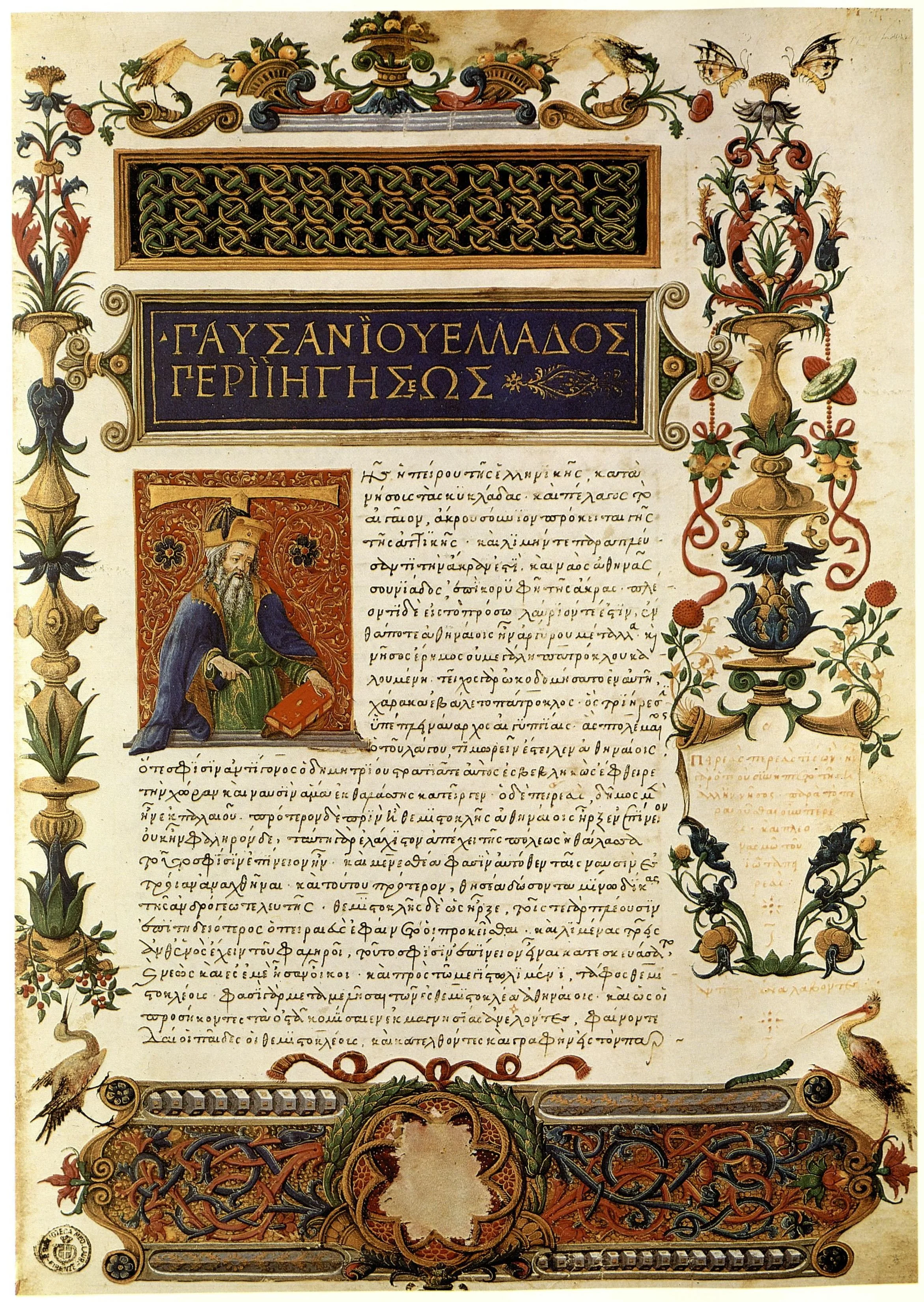
First folio of Pausanias’ Description of Greece, Biblioteca Medicea Laurenziana, Plut. 56.11, fol. 1r., Florence 1485 CE. Drawn from Wikipedia.
Pausanias was a Greek probably from Western Asia Minor, who lived in the Roman Empire at its height (2nd century CE). The entire Mediterranean world lay open to him, although we only know that he dedicated much time to visit and admire famous sites of the Greek Motherland, of which he prepared descriptions from autopsy to share with his contemporaries and the afterworld. His Hellados Perihegesis (“Travel through Greece”) is not known for its philosophical depth, coherent vision of history, or topographical scrutiny, but for the love of detail with which he accounts for the many minor and major pieces of art and monuments that he found exhibited throughout the cities or hidden in the temple treasuries. Since he was as interested in the artifacts themselves as in the stories told about them, his work has outlived the ages and became indispensable for ancient Greek art.
It is Rabbi Ben’s travel guide to go to when exploring sites and museums of ancient Greece - although his mind is the scene of a continual quarrel between them: the credulous reader ridiculed by the rational scholar. On his last trip he fell asleep while still being troubled by this tension. At some point - Ben cannot remember when or how - a creative force intervened and a door - hidden or at least unseen so far - opened to the litigants. They entered, took their seats on a wooden bench and listened to the middle-aged fully-bearded man in a grey tunic, lecturing to a very diverse class of men and women of all ages and dressed in the most diverse styles. He was just starting to speak, composed and slowly, but gradually began to raise and sometimes accelerate his voice, and to gesticulate with ever less restraint to make his points vividly …
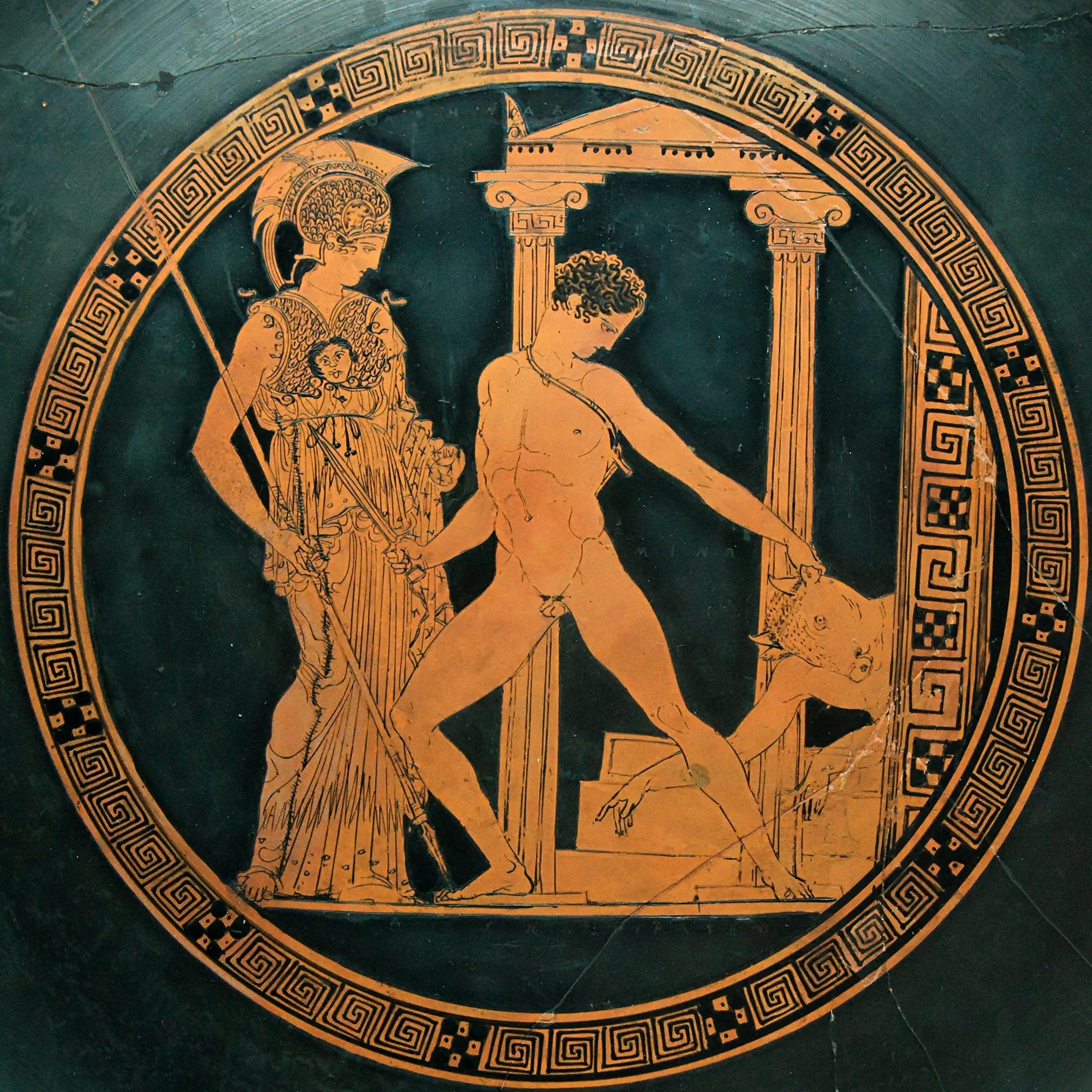
Tondo of the Aison Cup (late 5th century BCE), showing the victory of Theseus over the Minotaur in the presence of Athena. MNA Inv11365 n1. Photograph: Marie-Lan Nguyen, 2 May 2008, drawn from Wikipedia.
-
When I began visiting ancient sites, I thought many of the old stories foolish and sometimes had a hard time holding back my laughter or my critical questions. After all, I was raised to be polite and not to offend my hosts or tour guides or even the whole city that was welcoming me.
Over time, I was ever more pleased with my self-restraint, as I noticed that a traveler who laughs at everything he is told soon learns nothing. And so I listened. I listened to priests who showed me the places where gods had stood, to old men who knew which hero lay beneath an ancient stone, to guides who could tell me why a spring had its name. I wrote down what they said, even when I did not believe them.
There is much that men believe merely because they have heard it since childhood. The poets teach it, the choruses repeat it, and before a boy is old enough to ask whether a thing could have happened, he has already learned that it did.
Consider Theseus. I do not doubt that Theseus lived and was a king. His descendants ruled after him. These are things that belong to history. But must I therefore believe that he fought a creature with the body of a man and the head of a bull?
I have seen many strange things in my travels. I have never seen such a creature.
When I was younger, I thought that settled the matter. Remove what is impossible and perhaps what remains is the truth. A king remains when the Minotaur is gone. Thus one separates the grain from the chaff.
But by the time I came to Arcadia, I had begun to wonder whether I had been too quick.
The Greeks of old who were accounted wise did not always speak plainly. They spoke in riddles. They hid one thing inside another. The tale of Cronus, which once seemed to me merely absurd, I came to suspect might contain a kind of wisdom that was lost when men began to demand that every ancient story speak as plainly as an inscription on stone.
This does not mean that I now believe everything I am told. Far from it. Travel has made me harder to deceive.
But it has also made me slower to laugh.
Perhaps there is more than one way for an old story to be true. Perhaps the marvelous thing that never happened may nevertheless preserve something that did.
And so I began collecting these stories, sometimes finding some deeper meaning in them myself, sometimes not, and sometimes only years later when I returned to my notes or told these stories in conversation with others.
Let me share some of these stories with you, and you may decide for yourselves if they have any value other than commemorating the cultural heritage of localized Greek communities.
-
You may wonder why I write down small things.
I first began to understand this at Olympia.
I had heard of the great temple and the image of Zeus. Men cross the sea to see it. Poets have praised it, and those who have never stood before the god speak confidently of what Pheidias made.
Such things do not need me.
But when I came to Olympia, I discovered how much there was besides the things everyone knew. A statue stood beside another statue, a dedication beside another dedication, an altar beside an altar. Some commemorated victories known to every Greek. Others preserved the names of men whose victories had long been forgotten.
I began by asking the questions a traveler asks.
Who made this? Who dedicated it? How old is it?
Every answer led to another story. Sometimes two men gave me different answers. A guide confidently named the man represented by a statue; another told me the guide was wrong. Even at Olympia, where Greeks had gathered for centuries, memory did not speak with one voice.
And I began to notice the smaller things.
Outside a town there may be a stone beside the road. The people who live there tell you that a hero is buried beneath it. His name is not one Homer sang. Perhaps he defended that town in some war everyone else has forgotten. Perhaps he never lived at all.
Still, the people pour offerings there.
Should I pass by because the stone is small?
I have seen temples in ruins and statues whose names are no longer known. One man says an ancient image is Artemis; another says it is an older goddess whose name has been forgotten. I ask what I can. Often I leave knowing less than I wished.
But I have learned this:
Great things have many guardians. Small things have only the memory of those who live beside them.
And memory is mortal.
An old man dies, and the story he knew dies with him. A sanctuary falls. A village is abandoned. Men carry away the stones of an ancient building to make walls for a new one. Soon travelers pass without knowing there was ever anything there to see.
I cannot prevent this.
But I can write down what I saw.
The great temple and the broken stone belong to the same Greece. The story sung everywhere and the story remembered by one old priest are both parts of what we have received.
If I do not write down the small things, who will?
-
The city is large, and its people come from every nation. Its harbor is filled with ships, and merchants sell there things brought from countries whose names even I do not know. The citizens build higher than other men, as if they wished to leave as little distance as possible between themselves and the gods.
Near the center of the city, however, there is an empty place.
I asked what had stood there.
The man beside me named two towers. They had been greater in height than all the buildings around them, and sailors approaching the harbor could see them while the rest of the city was still hidden by the curve of the earth.
“They fell on the same day,” he said.
I asked whether they had been destroyed in war.
“Not war,” he answered.
Then, after a moment, he said, “Yes. War.”
I did not ask him which answer was true.
The day had begun with a clear sky. This was remembered by everyone. Men who could not recall what they had eaten the evening before could describe the color of that morning. Some had been walking to work. Some were already at their desks. Others were beneath the earth, traveling through tunnels toward the city. Each person remembered where he had been when he first heard.
This is one of the strange powers of terror. It divides a life into the time before and the time after.
The citizens have built at the place where the towers stood. Water descends into two great hollow spaces and disappears into darkness. Around them are written the names of the dead.
There are so many names that no traveler can remember them all.
This is why they have been written.
I saw a woman touch one name with her fingers. She did not weep. Perhaps she had wept before, or perhaps grief sometimes becomes too old for tears. She stood there for a long while, while strangers passed behind her.
A city remembers destruction in numbers.
A mother remembers one name.
The people told me many stories. Some concerned men who climbed upward while everyone else was descending. Others concerned those who carried strangers whom they had never seen before and would never see again. One man was remembered because he returned to help a companion. Another because, knowing that he would die, he spoke across a great distance to the woman he loved.
The poets would call such men heroes.
Perhaps they were. But I think that on that morning few had awakened intending to become heroes. They had expected only to work, to eat, to complain about small inconveniences, and to return home at the end of the day.
The city has built again, as cities must. Children who were not yet born when the towers fell now cross the place on their way to other things. New buildings rise above the harbor. Ships still arrive. Merchants still sell their wares. Those who look from a distance may think that nothing is missing.
Some say that this means the city has healed.
I do not know whether cities heal. I know only that they continue.
Before leaving, I turned back. The empty place was crowded with the living.
Yet it remained empty.